
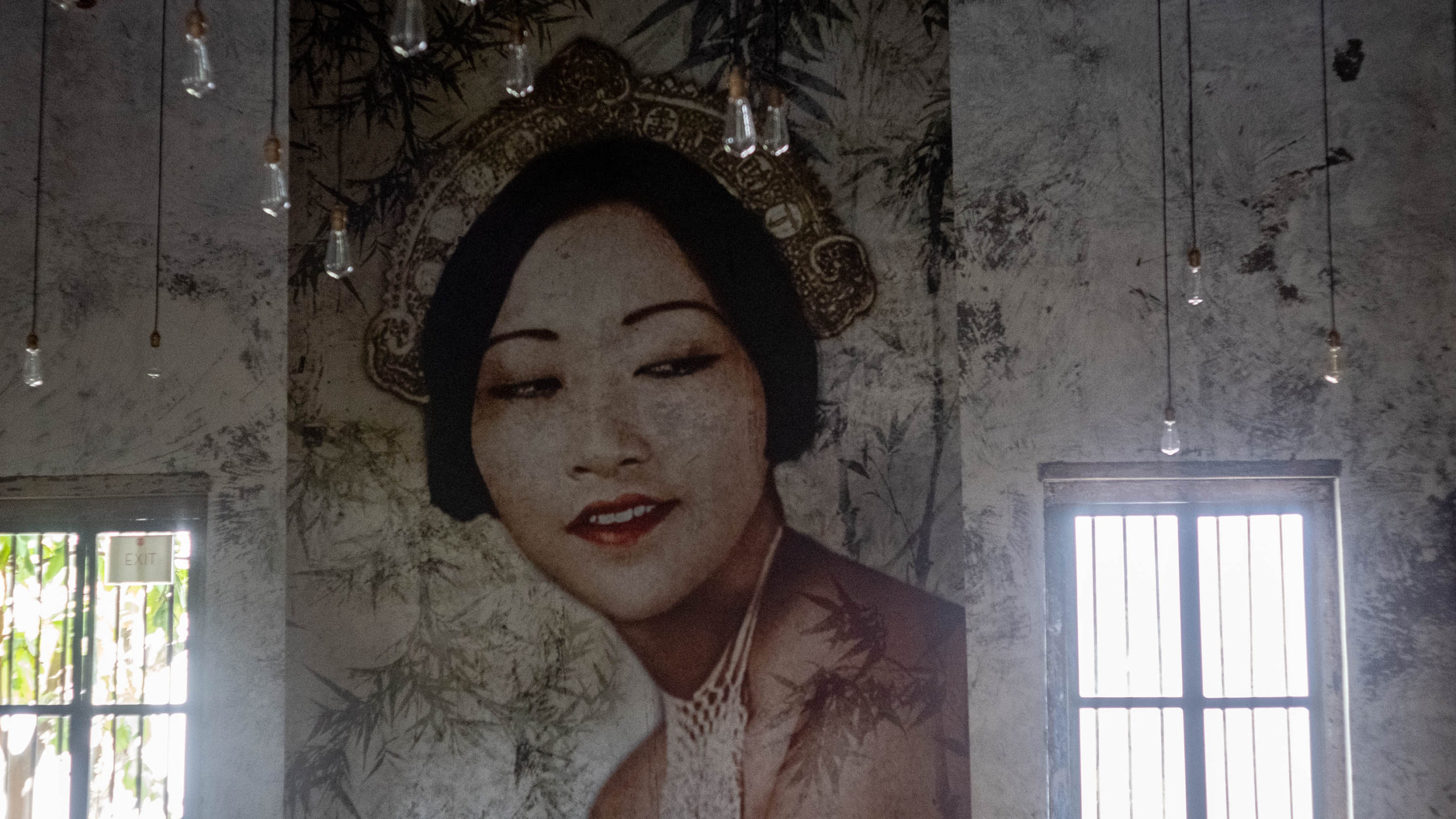
I never plan when in Phnom Penh. I walk it (or Grab it). The city doesn't give itself up to an itinerary — it surrenders to the loiterer, the one willing to take the wrong turn off Sisowath Quay and follow a strip of shade until something alters his path. This is my preferred travel mode of operandi, but Phnom Penh rewards it more than most. Its best places are unmarked. You find them, or rather they find you, somewhere between intention and accident.
It was the golden hour, the river going to brass, when I drifted past a façade I had no name for — shuttered, weathered, faintly imperious — and noticed a good crowd. Happy hour, as it turned out, with the kind of timing you couldn't engineer if you tried. So I went in. Behind the colonial front the building opened into something else entirely: brick rubbed back to its bones, distressed plaster, century-old tiles underfoot, antique Chinese cabinets standing in the half-light like patient witnesses. A local gin (herb laden) cocktail found my hand. The room was full of people who clearly belonged to it — artists, photographers, the city's beautiful and creative set — and for a good forty-five minutes, I was content simply absorb the scene that dropped me on a movie set.
Only later did I learn what I'd wandered into. The Chinese House was raised around 1904 by Tan Bunpa, a Sino-Khmer merchant who had bought the riverfront plot the year before, when Phnom Penh was still settling into its role as a capital. For decades his family lived here, where the Tonle Sap runs down to meet the Mekong — until the 1970s, when war and then the Khmer Rouge emptied the house, as they emptied the whole city. The family scattered into one of the darkest chapters any people has endured. Cambodia's ethnic Chinese were among the communities hardest hit of all — a merchant class of shopkeepers and traders devastated under Pol Pot. For years afterward the house passed through other hands; a researcher of old Cambodia lived in it for a time. Then, in 2007, one of Tan Bunpa's granddaughters — by then devoted to saving Phnom Penh's vanishing heritage — bought back her family's home and brought it slowly back to life.
That lineage is written into the walls. The core of the building reads like a trendy Paris loft, a merchant's warehouse-house, to which a French face was later added on the river side, its floors laid with Belle Époque tiles shipped in from a continent away. China and France and Cambodia, stacked in a single structure like sediment. It is the whole country in miniature: layered, interrupted, and somehow more beautiful for being a perpetual work-in-progress.
I might have left it there — a good drink, a handsome ruin — except one conversation led to another and became a plan. A small group of artists adopted me. By midnight we'd spilled out into the streets and onto the back of the night's own current: a gallery opening, a narrow bar, a rooftop where someone knew someone, the city unfolding exactly the way the old poets promised it would — every dead end giving way to another village. These weren't contacts I collected. They became, on later trips, my guide — the friends who text you where to actually eat, who pull you past the velvet rope of the obvious into the Phnom Penh that locals keep for themselves.
I came back the next afternoon with a camera, because some places ask to be remembered properly, and that was the truer reason for the journey anyway — to make the image, not just the memory. In the cool of the near-empty house I made the photo that now anchors this page: a young woman caught in the layered, double-exposed style I've come to love, the room's old light moving through her like a second photograph laid over the first. There was a rightness to it I didn't fully understand until I'd thought about whose house this was. The classic beauty of the Chinese women of Southeast Asia is a kind of living continuity — the same poised, unhurried elegance that built places like this one and outlasted the people who tried to erase them. To photograph her here, in the restored home of a Sino-Khmer family, was to photograph the influence itself: quiet, enduring, woven so deeply into Cambodia that you stop being able to say where one culture ends and the next begins.
The Chinese House poured its last cocktail a few years ago — eight good years, then dark again, the way these things go. But the house still stands, opened once more to the public in 2025 for its hundred-and-twentieth year, refusing, as ever, to disappear. I think about that night more than almost any other I've had on the road. It taught me the thing this whole project is built on: that you cannot schedule the best of a place. You can only put yourself in its path — on foot, unhurried — and trust that the door you didn't know to look for will be open right at happy hour, and that whoever's inside might just reshape your trip.