
There is a particular smile waiting at the centre of Angkor Thom, and once you have seen it you don't forget it. It belongs to the Bayon — Jayavarman VII's state temple, a grey mountain of stone that, as you approach, resolves into faces. Dozens of them, then hundreds, each wearing the same serene half-smile, gazing out over the forest in every direction. The guidebooks call it the Khmer Smile. Standing beneath it, you understand why it earned a name.
When the temple was rediscovered, its origins were fiercely debated. So much of it seemed Hindu — the bas-reliefs are thick with Hindu gods and scenes — that early scholars took it for a Hindu monument. The settled view now is that the Bayon was raised in the late twelfth or early thirteenth century as the state temple of Jayavarman VII, a Mahayana Buddhist king. That contradiction is the history itself: the king's own faith is thought to have moved through phases — first the Buddha, then the bodhisattva Lokeshvara, then a Tantric turn — and after his death the temple was reworked again by Hindu successors who carved their own gods into his Buddhist walls. The Bayon is a palimpsest, three religions arguing across four centuries of stone.
Walk the outer gallery and the carving softens from gods to people: fishermen hauling nets, market stalls, a woman in childbirth, men crowded around a cockfight, soldiers marching to war against the Cham. It is one of the few places in all of Angkor where you meet the ordinary Khmer — the farmers and cooks and children who actually filled this city — and not only their kings and gods.
At the heart stand the towers, fifty-four of them by the celebrated count, carved with two hundred and sixteen colossal faces, almost always read as Avalokiteshvara, the bodhisattva of compassion, though many see Jayavarman's own features looking back. One theory holds that the empire was divided into fifty-four provinces, and that each tower turned its four faces to the four directions so that no corner of the kingdom fell outside the gaze. The all-seeing eyes, keeping watch over every subject at once.
What stays with me, though, is not the watching. It's the contentment. These are not stern gods. The faces are confident, knowing, faintly amused — the expression of something that has seen everything and decided, on balance, to be pleased. They look like deities presiding over a kingdom that is doing well. The day I climbed onto the upper terrace I found myself among them at eye level, and the angles never ran out: a face in clean profile against the sky, two of them nearly nose to nose, one framed in a doorway with another smiling behind it. I lost an hour up there and barely noticed it go.
The Bayon is also, it should be said, run by animals. Macaques patrol the causeways and terraces with the entitlement of landlords, and cats drape themselves across the warm stone as though the whole complex were built for their afternoon naps. After the rains, shallow pools gather around the base of the temple, and the faces lean down to meet themselves — the smile doubled, floating on the water. Time your visit just after a downpour and the reflection is amazing to photograph.
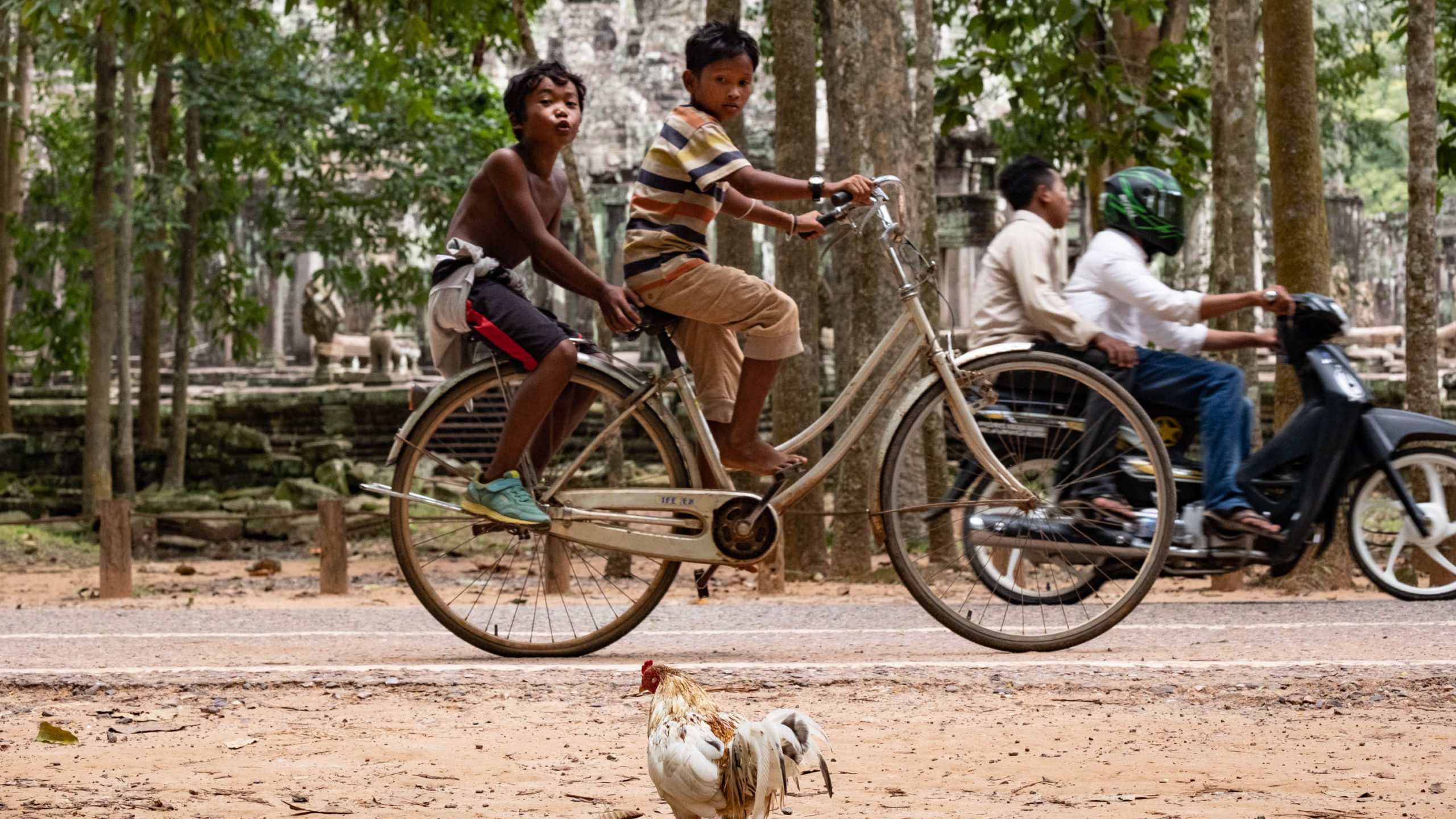
But the smile I think about most in Siem Reap isn't carved at all. Ride the back roads around the town and you pass children on bicycles everywhere — alone, in twos, in packs, pedalling the red-dirt lanes between the rice fields with nowhere in particular to be. No phones. No schedules, no parents hovering. Just kids, out exploring, the way every kid once was. It takes you back to something you'd half forgotten you ever had. I won't pretend life here is easy in the ways a visitor doesn't see — but there is a freedom in those small riders that the richer world has mostly traded away, and watching them is one of my favourite things about being in Cambodia.
Eight centuries ago a king carved his serenity into a mountain and turned it to face his people. The empire is gone; the faces remain, still smiling over the same green country. And on the lanes below them the kids ride past, smiling too — unbothered, unhurried, kings of their own afternoon. Maybe Jayavarman was onto something. It still looks, from here, like a good place to be content.