
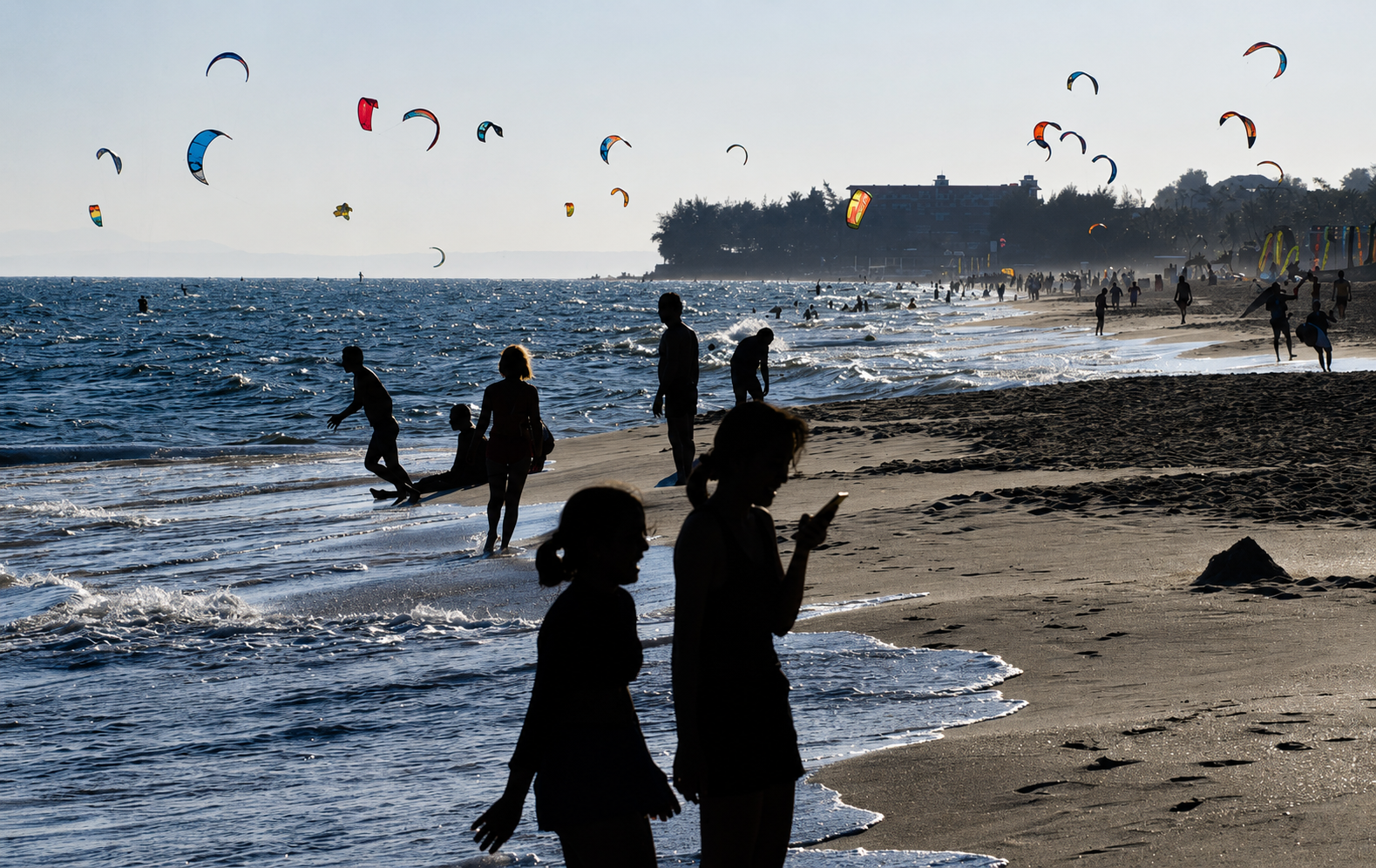
The kite grabbing the attention was a Russian guy (who I later met at the outdoor afternoon food court area south of town). On the beach, a German lady worked an undersized trainer in the shallows learning how to guide the kite. A local instructor was counting in jumbled English — the only language everyone reliably shared — while a man from San Diego tried not to look as terrified as he clearly was, lofted three feet off the sand and too committed to the situation to back out. A kitesurfing circus, but a hub that was equipped to accommodate it all without sacrificing anyone's style.
Mui Né is a narrow cape on the southern coast of Vietnam, pinned between red sand dunes and the South China Sea, about three hours from Saigon by car and somewhat longer by the patience required on a bus. The town sits administratively inside Phan Thiết, a provincial capital that most travelers pass through without stopping, and it has exactly one internationally branded hotel — an Anantara, tasteful and largely irrelevant to why people actually come. The rest of the accommodation runs local: family guesthouses, small resorts, the kind of place where the owner learns your name and has opinions about where you should eat. It is, by the metrics most people use to rank a destination, quietly unremarkable.
The wind here is the Gió Chướng — the northeast monsoon, which sweeps down the coast from November through March with reliable force. The Cham people who fished these waters for centuries before the Vietnamese pushed southward in the 1600s built their lives around this rhythm, reading the wind the way you'd read a timetable. Phan Thiết was the last capital of Panduranga, the final Cham kingdom, a Hindu-influenced civilization whose towers still stand in the hills above the coast — centuries of culture compressed into a name most visitors mispronounce. The Cham understood, long before anyone showed up with a kite, that this stretch of coast was where the wind kept them.
The kitesurfers found it in the late 1990s — a handful of Europeans who had been chasing consistent wind across the globe and ended up, more or less by accident, on this particular beach. Word spread the way it does among people who are serious about something: carefully, specifically, to the right people. By the time I arrived, Mui Né had become what serious travelers call a scene and what the travel industry hasn't quite figured out how to package — a genuinely international community that assembles here each winter, drawn by the same wind and held together by the kind of camaraderie that forms when strangers share a difficult and absorbing thing.
Kitesurfing is not a sport for the distracted. This is worth saying plainly, because the beach can make it look serene — kites arcing overhead, riders skimming the chop with apparent ease. What you don't see is the full weight of attention required to keep a twelve-meter kite in the power zone while simultaneously reading the water, controlling your board, and not crossing someone else's line in the process. The kite wants to be somewhere specific at all times, and your job, from the first lesson onward, is to understand where that is and stay slightly ahead of it. Most instructors suggest eight to twelve hours of proper tuition before you have anything resembling freedom on the water. That's honest advice. Budget $35 to $50 per hour; the schools along the beach are professional, most of the instructors are Vietnamese, though some are European or South American expats who came for a season and forgot to leave, and the equipment is usually included.
The kite becomes a direct extension of your attention, which means the moment your focus wanders, the kite goes somewhere wrong, fast. There is no coasting. This is not a sport that accommodates the casual. What it offers instead, once you've crossed the threshold, is something that feels distinctly earned: the realization of being lifted across the sea by nature is total freedom.
The wind dies off later in the afternoon, as the kitesurfers spill into the cafés and seafood tables along the coastal road. Becoming part of this community outweighs the forces of being from different political regimes. That said, the group is about respect and not small talk and chit chat.
Vietnamese coffee appeared first — strong, cold, unhurried, probably the best argument for slowing down that anyone has ever poured into a glass. Then the seafood. Mui Né sits on working fishing grounds; what arrives at the table at night came out of the water that morning. The conversation moved between languages and kept moving.
The focus of this trip was to build foundation skills for kitesurfing that I can build on going forward. There are many interesting destinations for this sport that I can access in the years to come. Mui Né may end up being my "go to" place given the excellent coffee and overall low costs for day-to-day. Having this common goal with other travelers breaks the ice in some instances and translates across borders. A bit awkward having breakfast with Russians each day until I realized there is no need for it to be. Our focus is the same and we have no bearing on what the elite have planned for our resources.