
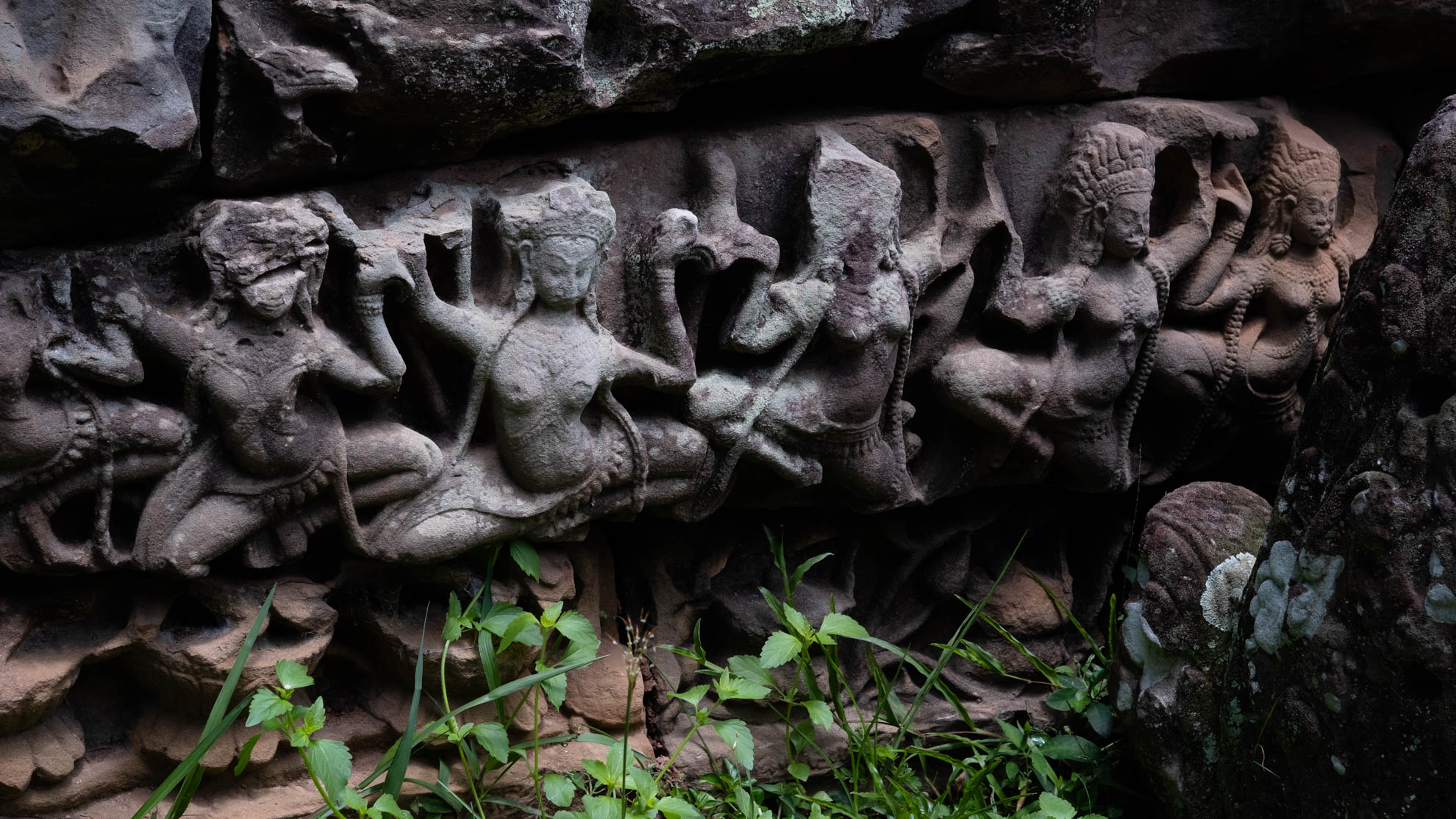
I try to avoid guides. Both kinds — the printed ones that tell you what to feel, and the human ones who block the gates. My whole way of traveling is a quiet argument against the middleman; I'd rather wander a place misled on my own than be walked through it and fed half truths. So when I came to Banteay Kdei, I used my normal mode of traval: rented scooter, unhurried, planning to lose myself in the mystical jungle of Siem Reap.
Banteay Kdei is the temple for that. The "Citadel of Chambers," they call it — a low, maze-like Buddhist monastery across the road from the royal bathing pool at Srah Srang, in the long shadow of its famous neighbor Ta Prohm. The crowds skip it. Built in poor sandstone that has slumped and softened over eight centuries, it has the half-collapsed, jungle-eaten beauty people come to Angkor hoping for, without the tour buses. It was exactly what I wanted, the temple was virtually empty. And then, at the eastern gate, a man started talking to me.
He was threadbare — secondhand clothes worn well past their second life, the kind of unwashed that comes from sleeping near where you work. But his English was immaculate, and he was relentless. Best photos, sir. I know the best photos. I gave him the polite brush-off I've perfected across a dozen countries and kept walking. He kept pace. Then, without being asked, he stopped, pointed me to a precise spot in front of a tower, and told me to stand there. I did, mostly to be rid of him. The frame through my lens was perfect — composed, balanced, the light doing something I wouldn't have found on my own. He pointed out another. I stopped pretending I knew better. We settled on three dollars for the full grounds.
What I got for my three dollars was a history lesson I didn't know I needed. Banteay Kdei was raised by Jayavarman VII, the great Buddhist king who pulled Cambodia back from ruin in 1181 and built half of what we now call Angkor — the Bayon, Ta Prohm, Preah Khan — at a frantic, monument-a-month pace. He dedicated this one to Avalokiteshvara, the bodhisattva of compassion, and stamped its gates with the serene four-faced smile you see all over his empire. His temples were Buddhist, but the remarkable thing about his Angkor was its tolerance: for centuries Buddhism and Hinduism shared the same walls, the same kings, sometimes the same shrines. The Buddha and Shiva kept company here.
Then the king died, and the company ended. Sometime in the 13th century — cresting under the Shaivite king Jayavarman VIII — came what historians call the Hindu Reaction, and the Buddhas of Angkor were systematically attacked. Heads struck off. Those compassionate faces chiseled into anonymity. Some were recut into Hindu lingas, the identity scraped clean out of the stone. At the Bayon, the great seated Buddha was smashed and thrown down a well. My guide narrated all of it evenly, the way you'd describe weather — and then he did the thing that made three dollars the best money I spent in Cambodia. He started finding the survivors.
Because the zealots were in a hurry, and they were sloppy, they missed some. And my guide knew exactly where they were hidden. A Buddha carved so shallow, set so deep in the shadow of a corridor, that the chisels passed it by in the dark. A row of Buddhist pediments that a later wall had been built straight across, sealing them out of sight and, by happy accident, out of harm's way. He walked me from one hidden Buddha to the next, forty-five minutes of them, telling me exactly where to stand for each, and I shot maybe sixty frames of faces. The deepest of them I couldn't photograph at all: in 2001, archaeologists dug up a pit on these grounds holding two hundred and seventy-four broken Buddhas, buried and sealed beneath the paving stones — hidden so well for seven hundred years before anyone found them.
By the end I'd have paid him twenty. I gave him five. He looked at the bill, looked at me, and said — completely deadpan — "how about ten?" I laughed out loud, standing there in the gallery with all those salvaged faces, and gave him the ten.
I think about that man more than I think about the temple. I went to Banteay Kdei to be alone with stone, faithful as ever to my conviction that the best of a place reveals itself only to those who refuse a guide. This guide had an unsuspecting level of intelligence that led me to incredible photos and a 700 year history lesson.