
I wasn't looking for a photograph. I was looking for lunch.
This is how most of my best images happen — not on the way to something, but in the gap between intentions. I'd been in Phnom Penh less than twenty-four hours, still calibrating to the heat and the noise and the particular density of the city, and I'd ducked off the main road into one of those half-shaded back lanes that Phnom Penh keeps tucked behind its busier face. The tuk tuk from the airport had dropped me into what felt, genuinely, like the modern-day wild west — a city operating on its own physics, its own schedule, its own understanding of what the rules are and when they apply. My sim card cost a dollar fifty. Everything else was negotiable.
And then I came around a corner and stopped.
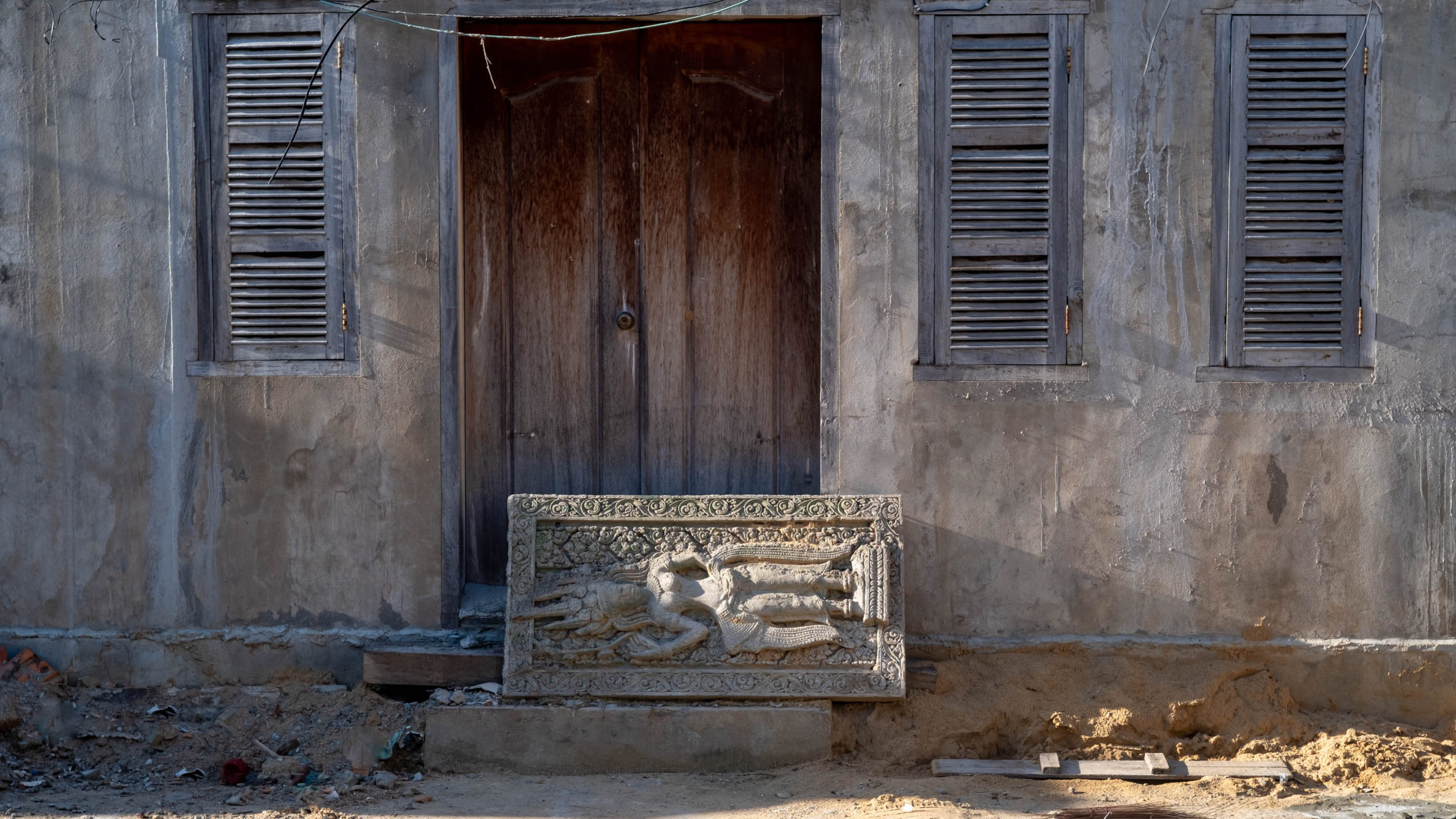
A crumbling French colonial shophouse. Shuttered louvred windows, the grey of old concrete that hasn't been painted in decades, an open doorway dark as a held breath. And leaning against the base of the wall, sitting in the dirt with no ceremony at all, a Khmer stone relief — ancient, intricately carved, a reclining figure surrounded by the dense decorative geometry you see in the temples at Angkor. Just there. Not in a museum, not behind a rope, not explained by a placard. Propped against a wall in a back lane, in the afternoon sun, the way you'd lean a bicycle.
I stood there for a while before I raised the camera. The image didn't need much — the scene had already composed itself. What I was looking at was the whole compression of Phnom Penh in a single frame: a thousand years of Khmer civilization sharing a wall with a hundred years of French colonialism, both of them weathered down to the same patient grey, neither one of them going anywhere. The city has a way of doing this — of leaving its history where it fell, unsanitized, uninterpreted, available to whoever walks slowly enough to find it.
That's what I mean when I say Phnom Penh has a surreal quality. Not surreal like a dream, but surreal like a palimpsest — layer written over layer, nothing fully erased. The French built their wide boulevards over the old city; the Khmer Rouge emptied those boulevards of every living soul; and then the city came back, slowly, stubbornly, filling in around the ruins and the memories and the beautiful broken things. You feel it walking. The corporate reality doesn't quite take hold here — there's too much underneath it, showing through.
I never did find that lunch spot. I shot the relief from a few angles, walked a little further, got turned around, and ended up at a noodle cart on a corner that someone gestured me toward. I ate standing up, plate in hand, watching the lane. A dog slept in the shade near the old doorway. Nobody else stopped.
The photograph is my favorite from the whole trip. It's not the most technically difficult thing I've ever made. But it's the one I keep coming back to — the one that, more than any other, holds the feel of what it's actually like to walk this city with your eyes open and your plans loose.